
|
|
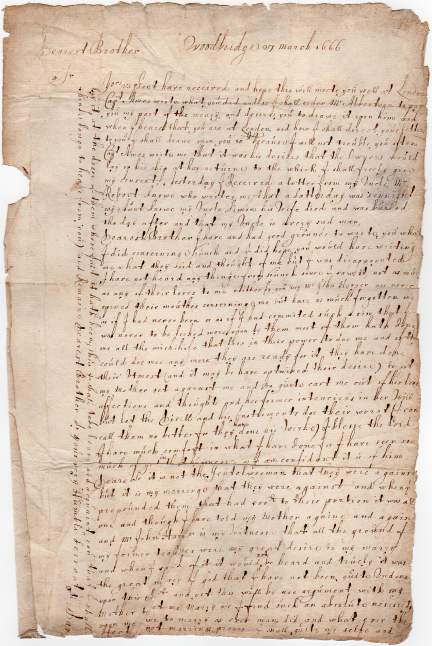
[PENGELLY, Thomas (fl. c. 1650-1696).] Merchant. Five Autograph Letters Signed to Pengelly by his business partner Samuel Davis, 6 pages folio (some dust-staining and creasing), Woodbridge, 27 March to 7 June 1666. Integral address panels with Bishop marks, seals and docketing, with complete transcripts. Reporting news of the Four Days' Battle in the Second Anglo-Dutch War, only 3 days after its end on 4 June 1666. Also writing about business arrangements, his domestic situation and the great plague. '... I suppose you have heard of the bloody fight it lasted 4 days great damage done of both sids the Royall Prince bournt Sr George Askgue and many of our men (with two of our second rate ships as feared) carred into Holland and our fleet sadly torne neare 12000 men of both sids slaine and wounded it is thought we have wounded and slaine 5000 men. ...'This battle was one of the longest engagements in naval history. The Prince Royal ran aground on the third day, and for what would be the last time in history a British admiral (its commander Sir George Ayscue) surrendered. Pengelly, a merchant who made his fortune trading with the eastern Mediterranean and father of the judge Thomas Pengelly (1675-1730), was the London agent of the owners of the merchant vessel The Returne. Joseph Ames (1619-1695), formerly a naval commander during the Commonwealth, was Master and part-owner of the vessel; his letters to Pengelly between 1663 and 1674 are held by the British Library (Add. MS 57491). Samuel Davis was also a part-owner, and his letters discuss plans for Ames and the ship, among other business matters ('... the lowe price of Coales gives little incurragement to send Capt Ames his shipe any more tell wee have better incurragement, and when you write Mr Albertson you will doe well I thinke to hinte as much to him that it is your mind likewise that Capt Ames may lay up his shipe when she returnes tell a fitter oppertunity to send her forth. ...'). Of great concern to Davis throughout this period are his marriage plans, which appear to be linked to business interests and reputation as well as to his mother's approval ('... truely it was the great mercy of god that I have not been quite undone upon this Acct and yet this will be noe argument with my Mother to let me marry ... I find such an absolute nesessity upon me nowe to marry as ever man did and what ever the efects of not marringe proves I shall quite my selfe and lay it at the doore of them whose falt it hath been. ...'). Of interest also are his mentions of the great plague, still coursing through London in the early summer of that year, his forays into book-buying, and his hatred of Yarmouth ('... I had rather as the old saying is be hanged then to goe nowe and live there....'). A window onto commercial and domestic life during an infamous year in London's history. The Great Fire was to start on 2 September. [No: 25472] The image is of the first letter. The image links to a larger or more detailed version.
| |