|
|

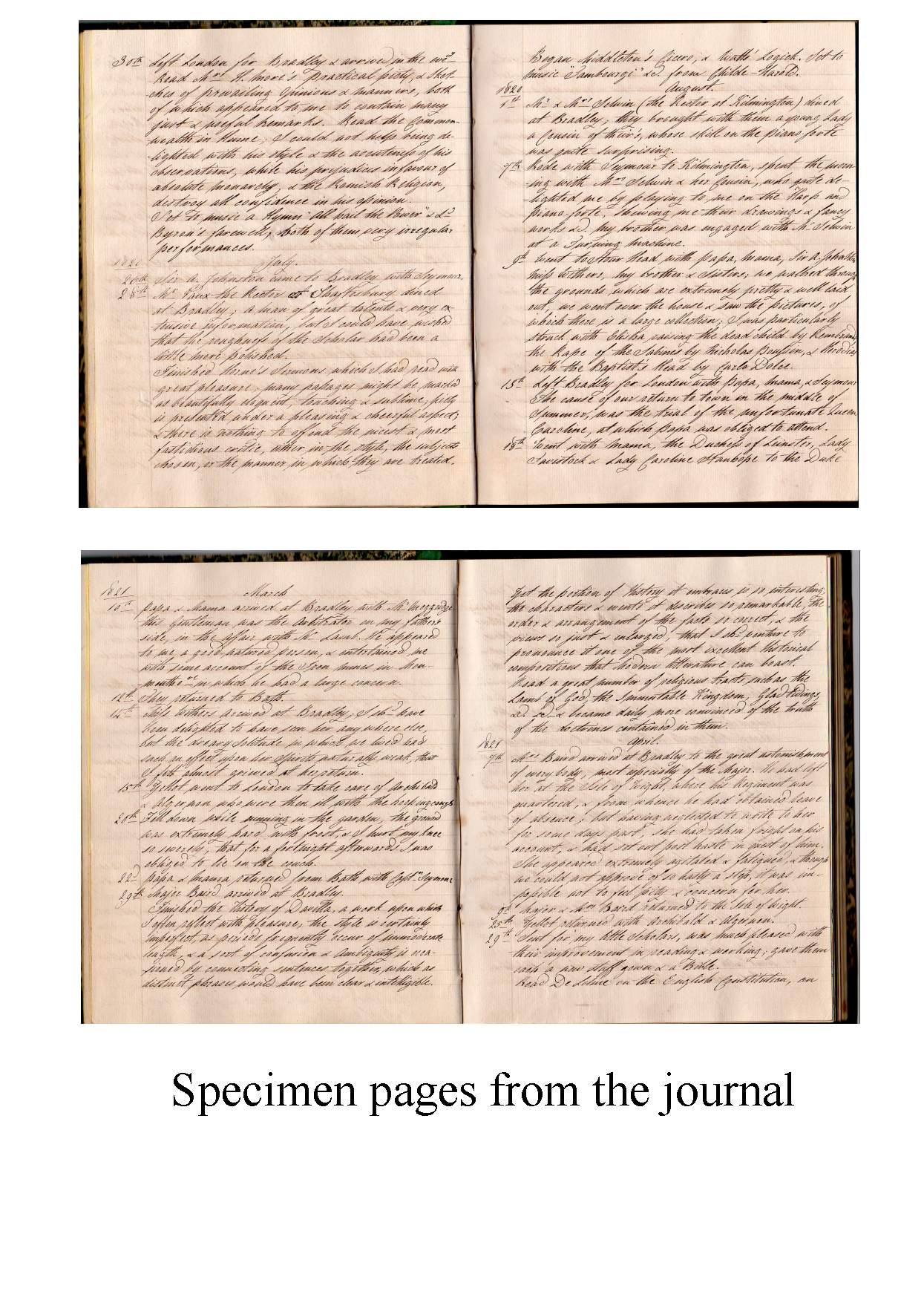
Lady Charlotte Jane St Maur (1803-1889). Her youthful journal, together with related correspondence and pictures. Lady Charlotte Jane Street Maur [Seymour] (1803-1889), was the eldest child of Edward St Maur, 11th duke of Somerset. She became a member of the household of Victoria, duchess of Kent, mother of the future Queen Victoria, and in 1839 married William Blount of Orleton, Herefordshire. Her youthful journal, ca 152 pages 4to in a very neat small hand, consistent throughout, inscribed 'Notes, Memoranda / Charlotte Jane Street Maur' on the flyleaf, bound in paper-covered boards, 1819-1824 (October to December 1822, the last few days of December 1823 and three days at the end of April 1824 excised). Together with two series of letters. The remarkable journal of a privileged young lady, comprising detailed lists of her reading and an account of her daily life, particularly many excursions and visits, including travel between the family homes at Bradley (Devon) and Park Lane (London). There are reference to Charlotte's reading throughout the journal, and it commences with 'List of Books I had read before the age of [blank]', starting with eight volumes of history, including [Elizabeth] Helme's Abridgement of English History, and works by [William Fordyce] Mavor, [The Abbé de] Vertot, and [William] Robertson, as well as poetry by Pope, Gay, and La Fontaine, and upwards of two dozen other works of poetry (including Shakespeare's historical plays); a number of novels and works of fiction (several in French) including Pride and Prejudice (published 1813), Guy Mannering, the Castle of Otranto etc.; 'Voyages, Travels'; Miscellaneous (including works on science and natural history), and 'Sacred and Moral'. The volume concludes with a further 'List of Books I had read from the age of fifteen to twenty-one. 1819-24 inclusive'. A comprehensive list, divided as before into categories, and including many works in French, much Walter Scott, and Maria Edgeworth, Vathek, and 'Confessions of an Opium Eater', etc. etc. The picture that these pages present is of the life of an extraordinarily mature and not-entirely-leisured young lady in the early years of the nineteenth century. The journal is quite remarkable and contains much detail. Charlotte was a voracious reader, an acute observer of all around her, and a pianist and composer of music. The book opens rather propitiously with this entry [at the age of fifteen]: 'I was at Bradley with my sisters; I had undertaken the office of Governess which I found extremely troublesome to myself, & not very advantageous to my pupils; I read Cuvier's Theory of the Earth, translated by Professor Jamieson; was much interested in it, and astonished at the wide field of conjecture that was suddenly open to me; found my total ignorance of mineralogy a very great loss. ...' It is evident that this is the work of a mature and sensitive young woman, not given much to vain pursuits but deeply scholarly in her interests and quite remarkably well read, often working her way through several books simultaneously, and commenting on them with considerable sagacity and maturity. 'Likewise Locke's History of navigation, which I should call an admirable work of its kind. It gives clear and succinct account of the progress of navigation from the earliest times of which we have any record, & carries it down to the period in which the author wrote, accurately describing all the principal alterations & improvements that have taken place in that useful art, & furnishing a brief history of the most remarkable voyages that have been accomplished. I had only to regret that the author sh[oul]d have confined himself to so small a Volume ...' [The work is not now regarded as by John Locke]. She comments on [John] Locke ('On the Conduct of the Human Understanding' [sic]) as 'entirely lost upon me, as I had scarcely any idea of metaphysics'; on Paley's Evidences - 'I was pleased with the style, & with the manner in which the argument is conducted'; and on Byron (the first and second cantos of Childe Harold). etc. etc. She saw Kean in King Lear; visited Newgate prison, where she met [Elizabeth] Fry (and comments at length on the regime of the prisoners); saw Madame Vestris in David Rizio; visited Chantrey's studio; witnessed Queen Caroline arriving at the House of Lords for her trial, etc. etc. Having given up her own position as governess to her siblings, she came under the tutelage of Miss L. Withers, who appears in this passage:
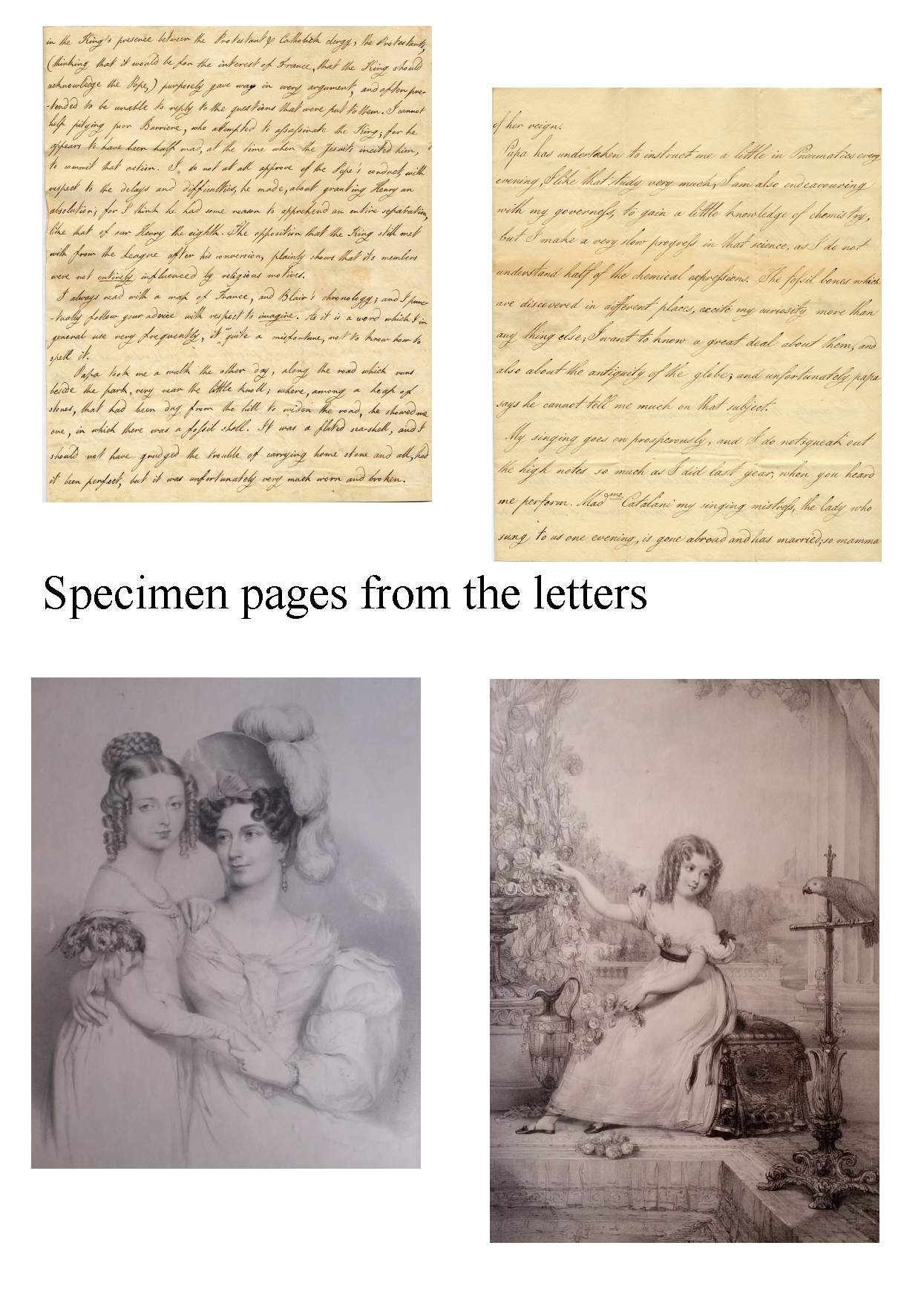
A treasure trove of social history, casting light on the daily life of a young woman perhaps more than ordinarily studious but therefore more observant. The whole can be read with ease and would benefit from transcription and probably from publication. LETTERS Charlotte St Maur to Victoria, Duchess of Kent, a retained copy, 3 pages 4to, 19 September 1833, resigning her position in the royal household. (Sir) John Conroy to Lady Charlotte, 2 pages 4to, Norris Castle, 20 September 1833, expressing his own and the duchess's regret at her resignation. Victoria, duchess of Kent to Lady Charlotte, Four ALsS: 3 pages 4to, Norris Castle, 22 September 1833, accepting the resignation and expressing her own and her daughter Victoria's regret and their wish for a continuing friendship. 3 pages 8vo, Kensington Palace, 11 July 1856, in answer to a letter announcing Charlotte's father's second marriage. 3 pages 8vo, Norris Castle, 23 October 1833, expressing the hope that she would continue in the household as an honorary lady in waiting ('without any duties'). 3 pages 8vo, Buckingham Palace, 27 March 1837, congratulating her on her intended marriage. Louise Lehzen, to Charlotte, 2 pages 8vo, Pavilion [Brighton], 4 January 1839, asking her to call on the duchess before leaving Brighton. Charlotte St Maur, ALS to Lady Jersey, 3 pages 8vo, 5 Hyde Park Terrace, 'Saturday', no date, assuring her that there was no coolness between herself and duchess in consequence of her resignation. Lady Jersey to Charlotte, 2 pages 8vo with address wrapper, no date, returning her letters (presumably sent with the above) with thanks for letting her read them. Lady Charlotte Jane St Maur A series of sixteen lengthy ALsS from Charlotte, 12 to her uncle Lord Webb John Seymour (1777-1819, fellow of the Royal Society) and 4 (all in French) to her father, the duke of Somerset, 11 November 1817 to December 1818. A wonderful series, particularly the letters to her scientifically inclined uncle, full of scientific curiosity as well as tales of her daily life and comments on her reading. Two fine engravings after Hayter, of the duchess of Kent with her daughter Princess Victoria and of Victoria with her parrot, both framed and glazed, one with a label to the reverse identifying them as gifts to Charlotte from the duchess. Specimen pages from the journal Specimen letters etc. [No: 25651]
| |