
|
|
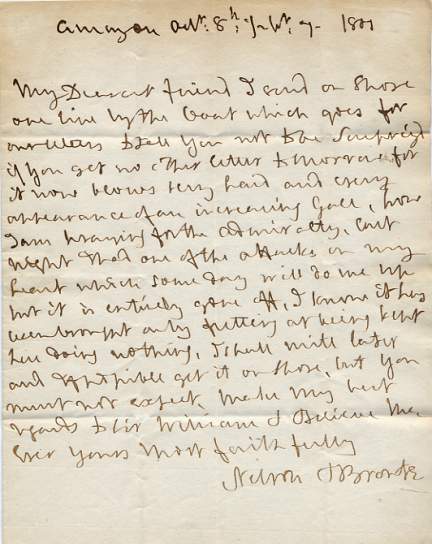
NELSON, Horatio, Viscount (1758-1805). Vice-admiral. Autograph Letter Signed ('Nelson & Bronte') to Emma Hamilton, 1 page 4to with address-leaf also signed in full, Deal, Amazon, 8 October 1801. A remarkable and hitherto unknown and unpublished letter, in near-perfect condition, in which Nelson tells of the symptoms of heart-disease 'which some day will do me up'. Written at the end of a period of intense frustration following the brief campaign during which he had suffered his only defeat at the hands of the French. Nelson was on board the Amazon (a 38-gun frigate under Captain Samuel Sutton) as Vice Admiral, off the port of Deal, and was eagerly awaiting the discharge that would enable him to join Emma (and her husband Sir William Hamilton) at Merton, the house which Emma had bought for him during his absence. Although the address of the letter at the head is 'Amazon', the address-leaf gives 'Deal' and the same date, and is addressed to Lady Hamilton at the Hamilton's London house at 23 Piccadilly. In the summer of 1801 Britain had become embroiled in an invasion scare and had in rather a panic assembled a force under Nelson's command, the largest fleet that he had ever commanded. The idea was to prevent the forces believed to be massing in Boulogne from crossing the channel. The British fleet comprised many small and fast-moving vessels. Although by 15 August Nelson had become aware that the invasion would not come from Boulogne he nevertheless attacked the line of French ships defending the port with four divisions of his own, a fifth division being instructed to provide covering fire. In the event the French were well prepared and counter-attacked with heavy fire and the British ships became separated in the dark and by the strong tide. Their losses were heavy: 45 dead and 128 wounded. Nelson suffered a good deal from ill health during his career, including, perhaps surprisingly, seasickness and 'a cocktail of diseases contracted during the expedition to Fort San Juan, Nicaragua' (Colin White, The New Letters, 2005, p. 133n.) In this year of 1801 he had complained to Evan Nepean that he had 'nothing less than a consumption', and in April that 'my spirit is stout but my Constitution is gone'; a month later it was 'a most wretched state of health'. Colin White notes (op. cit. p. 266n) that 'Nelson had a curious faith in the efficacy of 'asses milk', and he often mentions it in his letters as a possible cure for his various ailments. Possibly, it was a favourite remedy of Emma's.' It is not clear to what specific illness Nelson may be here referring in respect of his heart, although it is perhaps significant that he reserves this particular one of his many symptoms for Emma. 'My Dearest friend I send on shore one line by the boat which goes for our letters to tell you not to be surprizd if you get no other letter tomorrow for it now blows very hard and every appearance of an increasing gale. ... last night I had one of the attacks on my heart which some day will do me up but it is entirely gone off. I know it has been brought on by fretting at being kept here doing nothing. I shall write later and if possible get it on shore, but you must not expect. ...' Not in The Dispatches and Letters of Vice Admiral Lord Viscount Nelson, ed. Sir Nicholas Harris Nicolas (1845), nor The New Letters, ed. Colin White, 2005; it is not printed in The Hamilton and Nelson Papers ... formed by Alfred Morrison , privately printed, 1893. It would appear, therefore, to be an unknown and unpublished letter. Nelson's signature changed with his various honours. Beginning simply as 'Horatio Nelson', written after July 1797 with the left hand, it became 'Nelson' after 1 August 1798 when he became Baron Nelson; it then changed to 'Bronte Nelson' after the king of Naples made him Duke of Bronte on 13 August 1799, altering to 'Bronte Nelson of the Nile' when Nelson discovered that his full English title included the extra words. It was in late 1800 that Nelson learned that he it was not a good idea to put his foreign title before his English one, and he decided upon 'Nelson & Bronte' [invariably with the ampersand], which is the familiar signature of his later years. [No: 26155] The first image is of the letter itself. The image links to a larger or more detailed version. |
|
|