
|
|
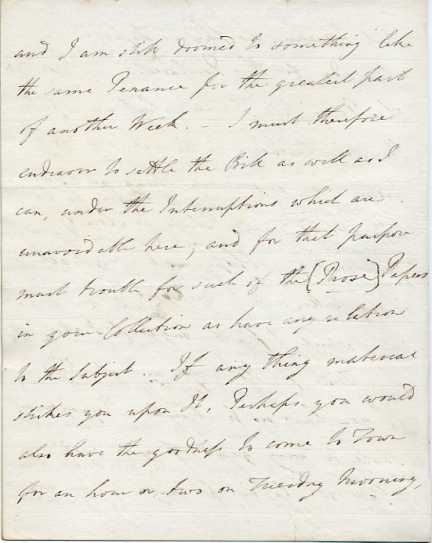
PITT, William, the younger (1759-1806). Prime Minister 1783-1801 & 1804-1806. Fine Autograph Letter Signed, as prime minister, [to William Eden, Baron Auckland (1744-1814)], 3½ pages 4to, Downing Street, 18 December 1796. Expressing the hope of completing his work on the Poor Bill so that he could commence his Christmas holidays, inviting himself to visit Auckland at Christmas, and sending veiled diplomatic news from the Continent. 'Among the labors to be completed before my holidays can begin, one which still remains, is the Poor Bill, which I had hoped to find at least one day for correcting with you at leisure in the Country. The different Points of Business, and the number of persons to be seen, have not allowed me to stir from hence for more than an hour except to the House of Commons, and I am still doomed to something like the same penance for the greatest part of another Week. I must therefore endeavour to settle the Bill as well as I can, under the Interruptions which are unavoidable here; and for that purpose must trouble for such of the (Prose) Papers in your Collection as have any relation to the subject. ... 'Mr. Pitt introduced a Poor Law Bill in 1796 which, it is not too much to say, contained some of the most ill-considered and mischievous proposals that were ever submitted to parliament. It is now chiefly remembered by having called forth from Bentham the scathing criticism of his "Observations on the Poor Law Bill February 1797."' (A History of the English Poor Law, 1899) 'In his famous Poor Law Bill, the proposal was made by Pitt that children should be set to work at the age of five. Children of six and seven were employed on a widespread scale, and their hours were incredibly long. Twelve to fifteen-hour schedules were common.' (Jesus or Christianity, by Kirby Page (1929). [Quotations courtesy of Wikipedia]. It is difficult to imagine what 'promising' news can have come from Italy at this time. Earlier in the year Napoleon had invaded Italy, taking Milan and plundering Lombardy and Tuscany before entering Leghorn. Sardinia had abandoned its friendship with the allies, including Britain, and Naples withdrew its ships from the British navy and sued for peace. Auckland had remained close to Pitt after his diplomatic career had run its course. At about this time he came very close to marrying Pitt's daughter, Emily Eden, although for reasons never explained the engagement was abruptly terminated. Auckland's political pronouncements were often presumed to have originated with Pitt. [No: 26182] The image is of the second page only.
| |